The Psychology of Curved vs. Sharp Shapes in Logos
Curved vs sharp shapes in logos send very different signals, and people pick them up instantly. People judge a logo before they read it. In the first second, before the name or the tagline registers, the shapes have already sent a message: friendly or strong, soft or sharp, safe or fast.
That’s not a design myth. It’s one of the most tested ideas in visual psychology. And it’s one of the most useful decisions you make in a logo project, because once you pick a shape direction, everything else (type, icon, even the colours) follows it.
Here’s what curved and sharp shapes communicate, what the research says, and how we decide which way to go on client projects at LogoFarmers.
These are tendencies, not rules. The right choice depends on what your brand needs people to feel, not on your industry alone.
Why shapes have meaning: the science
Three findings explain why this works so reliably:
The “bouba/kiki” effect. Show people a rounded blob and a spiky star and ask which one is “bouba” and which is “kiki”. Across languages and cultures, almost everyone calls the rounded one bouba and the spiky one kiki. Our brains link shapes to sounds and feelings automatically.
We tend to prefer curves. Studies of everyday objects have found that people usually like curved versions more than sharp-angled ones. One explanation is that sharp edges read as a possible threat, even when they’re just lines on a screen.
Logo shape changes how a product is judged.Research published in the Journal of Consumer Research (Jiang et al., 2016) found that circular logos made people expect products to be softer and more comfortable, while angular logos made them expect products to be harder and more durable. Same product, different logo, different expectations.
So the choice between curved vs sharp shapes in logos isn’t just decoration. It sets expectations about the product itself.
What curved shapes communicate
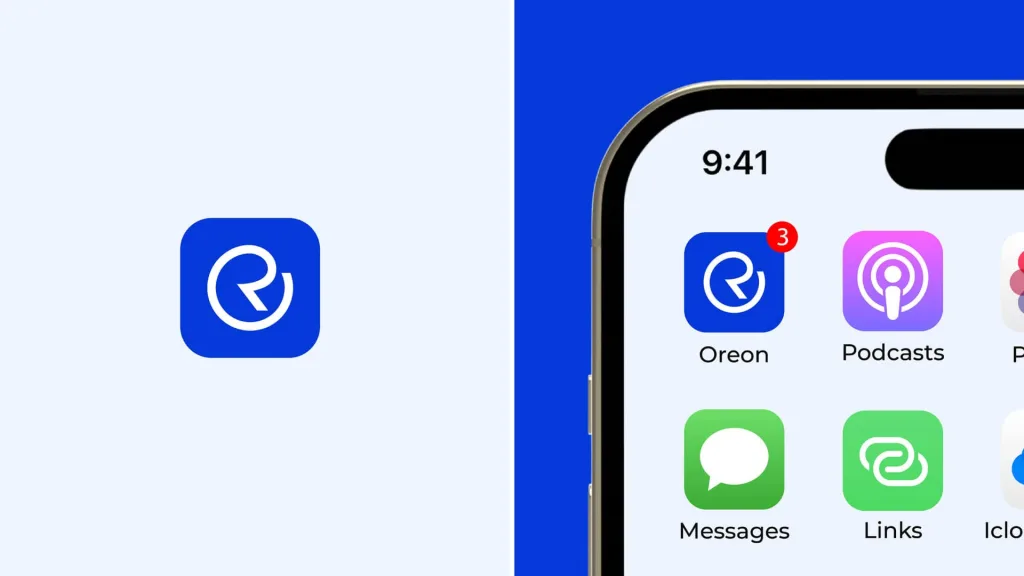
Oreon: a rounded mark that feels friendly and easy to use.
Curves feel soft, continuous and human. Circles and rounded forms have no starting point and no edge, so they suggest wholeness, community and protection.
Curves work well when your brand needs to feel:
approachable and easy to use
caring, safe or gentle
playful or creative
inclusive and community-led
Watch out for: too many curves can make a brand look soft, childish or forgettable. Rounded sans-serifs plus circle marks are everywhere right now, so a curved logo still needs one distinctive idea to stand out.
What sharp shapes communicate
Strike: sharp angles and diagonals built for speed and energy.
Angles, points and straight edges feel deliberate. They suggest precision, power and direction. Diagonals add speed, because they look like something is moving forward or about to fall.
Sharp shapes work well when your brand needs to feel:
strong, durable or high-performance
fast and forward-moving
precise, technical or expert
confident and in control
Watch out for: too much sharpness can make a brand feel cold, aggressive or hard to approach. That’s a problem for a brand that also needs customers to feel welcome.
A quick guide to basic shapes
Circle / oval: unity, community, protection, completeness
Triangle: direction, power, progress (pointing up feels stable and ambitious; pointing down feels unstable or urgent)
Diagonals: movement, speed, energy
Vertical lines: strength, growth, aspiration
Horizontal lines: calm, balance, groundedness
Use this as a starting vocabulary, not a formula. Context, colour and typography all change how a shape is read.
The best logos often mix both
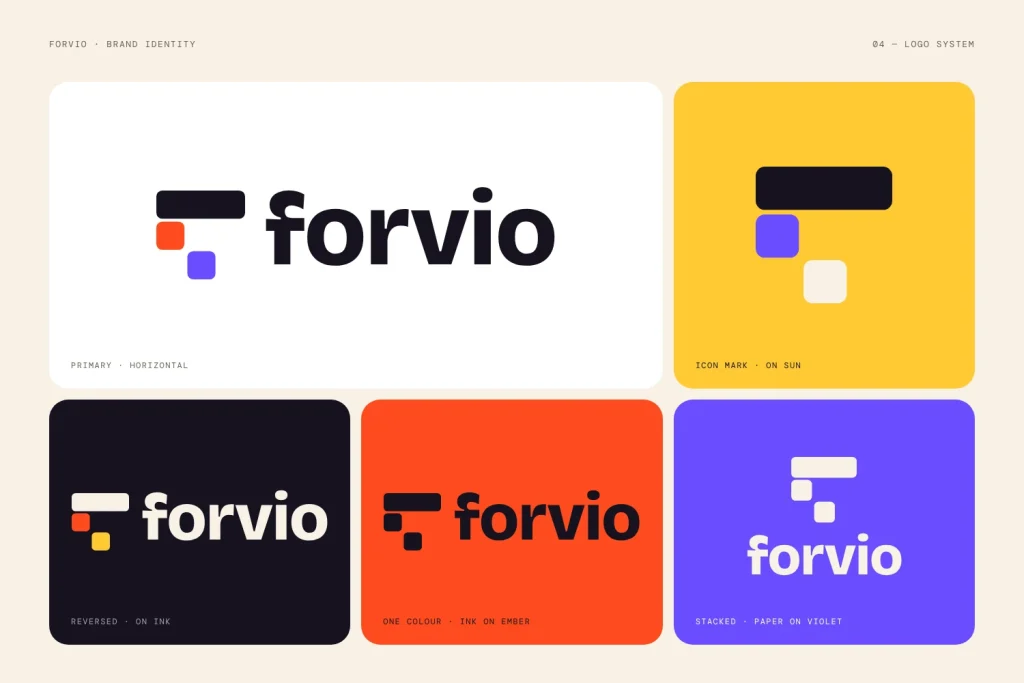
Forvio: geometric blocks for structure, rounded corners and soft type for warmth.
Most brands don’t want to be only soft or only sharp. A fintech wants to feel secure and friendly. A sports brand for kids wants energy and safety. That’s where mixing works:
Sharp structure, soft details: a geometric mark with rounded corners feels organised but still approachable.
Curved mark, firm type: a rounded symbol paired with a solid, upright typeface balances warmth with credibility.
One sharp moment: a single cut, notch or angle in a curved form can add tension and make the mark more memorable.
The key is to choose a lead shape and let the other one support it. Equal amounts of both usually look undecided.
Don't forget the typeface
When you weigh curved vs sharp shapes in logos, don’t stop at the symbol. The letters do half the work:
Rounded sans-serifs feel friendly and casual.
Geometric sans-serifs feel modern and clean.
Condensed, angular or italic type feels fast and powerful.
Sharp serifs feel premium, editorial or traditional.
Small details matter here too: rounded or squared stroke ends, the corner radius, and how tight the letter-spacing is can all push the wordmark softer or sharper.
How to choose the right direction for your brand
This is the process we use to decide between curved vs sharp shapes in logos, before sketching anything:
Pick three feelings. Write down the three things you want people to feel in the first second, e.g. “safe, calm, expert” or “fast, bold, reliable”.
Place each word on a scale from soft to sharp. If most words land on one side, that’s your lead shape.
Check the audience. Who needs to trust you? A logo for parents and a logo for engineers can sell similar products but need different shapes.
Look at competitors. If everyone in your market is rounded and friendly, a sharper mark can help you stand out, as long as it still fits your brand.
Test small and in black. View your options at favicon size and in one colour. Shape is the only thing left at that point, so it’s the clearest test of the feeling.
Curved vs sharp shapes in logos: FAQ
Are curved logos better than sharp logos?
Neither is better. Curved shapes are often liked more on first sight, but sharp shapes are better at communicating strength, speed and precision. The right one depends on what your brand needs to say.
Which logo shape builds the most trust?
Squares and solid, balanced forms often read as stable and reliable. Circles read as safe and protective. Trust usually comes from consistency and clarity more than from one particular shape.
Can a tech company use a curved logo?
Yes. Many consumer tech brands use curves to feel friendly and easy to use. A tech brand selling to engineers or enterprises may lean sharper to feel precise and robust.
Does shape matter more than colour?
They work together. Shape is the part that survives when colour is removed (on a fax, a stamp or an embossed card), so it should carry the brand’s personality on its own.
Need help choosing your shape language?
At LogoFarmers, every logo starts with strategy: how your brand should feel, who it’s for and what makes it different. Then we choose between curved vs sharp shapes in logos (or a mix of both) and design a mark that says it without words.